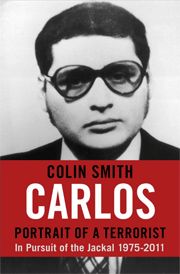
Carlos - Portrait of a terrorist
| |
 |
| |
|
AUTHORS NOTE
Tell them Im the famous Carlos, he instructed the Iraqi chargé in
Vienna where, shortly before Christmas 1975, he and a gang of Palestinian and
German guns for hire shot their way into the Organisation of Petroleum Exporting
Countries and took eleven oil ministers hostage.
Fleet Street preferred to call him The Jackal. In the first decade
of a century plagued by monkish suicide bombers, their identities forgotten almost
as soon as the videoed farewells released by their controllers fade from our
screens, the chubby Venezuelan hedonist Ilich Ramirez Sanchez now seems like
a creature from a remote past. Brought up in Caracas, London, Moscow and Paris
he is the son of a doting Catholic mother and a lawyer who converted to Marxist
Leninism naming his boys Lenin, Ilich and Vladimir. In the early seventies he
was one of several foreigners - mostly Germans and South Americans - who joined
the leftist Popular Front for the Liberation of Palestine in Lebanon. (It was
founded by Dr George Habash, who was born into a Christian Palestinian family.)
Thus began a career that was often as bungled as it was pleasure loving and started,
as it continued, soaked in the blood of innocents with a grenade tossed in a
crowded Left Bank café owned by a Jew and Edward Sieff surprised in a
bathroom of his London home and shot in the face. Long life and the practise
of terrorism rarely go together but Carlos survives, albeit serving a life
sentence in a French jail from which, barring some daring escape, he will
only emerge alive
as a very old man.
This was my first book and was published by Andre Deutsch in London and Holt,
Rinehart and Winston in New York. French, Spanish and Finnish editions followed.
Then six months after Carlos capture in August 1994 the Mandarin paperback
edition, considerably revised and lengthened by 35,000 words, appeared.
The original book grew out of a three part Review Front series of about 10,000
words I wrote in 1976 for The Observer, then owned and edited by David Astor.
In them I was given the time and space to investigate the two events which, in
the space of six months between June and December 1975, had earned Carlos the
notoriety he yearned for. These were the shootings in Paris of a Lebanese informer
and three agents (one survived) of the Direction de la Surveillance du Territoire,
the French security service. The other was the kidnapping of the eleven oil ministers
of the Organisation of Petroleum Exporting Countries as they sat in session in
Vienna.
The Mandarin edition enabled me to correct some of the errors which occurred
in the original version because I was writing too close to the events in question.
Some eyewitnesses, for very understandable reasons, were not so forthcoming then
as they were twenty years later . For instance Suhail Nasser, a Lebanese citizen
who was working for the Kuwaiti oil ministry and part of its delegation to OPEC,
told me about the death of Yousef Ismirli, a gallant Libyan gentleman who came
close to making Carlos story a much shorter one. At the same time I have
had to revise my opinion about the involvement in the OPEC raid of Ismirlis
boss, Colonel Qadaffi. Originally I could find no evidence for it. This is no
longer the case. The reasons for my change of mind become apparent towards the
end of Chapter Twelve.
In other respects I have had the satisfaction of being proved right about events
that, for the most part, could only be the subject of speculation at a time when
Europe was divided and those chinks in its iron curtain that existed often revealed
no more than a tantalising shadowland. In those days I discussed the possibility
that the young Venezuelan was run by the KGB and its fraternal Warsaw pact intelligence
services with additional help from Cubas Direcion General de Inteligencia.
(Just as contingents of the Cuban army did Moscows bidding in Africa, particularly
in Angola.)
It now turns out that Carlos, who had been expelled from Moscows Patrice
Lumumba University, did indeed enjoy for many years the protection of some of
the Communist governments of Eastern Europe, particularly the East Germans and
the Hungarians. He was shielded and, to a certain extent, controlled by their
intelligence and security services. Carlos and the middle-class West German terrorists
of the Baader-Meinhof gang, or the Red Army Faction as they preferred to call
themselves, frequently operated out of East Berlin. Just after the wall came
down, and on the eve of German unity, what was left of the old GDR authorities
obligingly arrested eight of them. Markus Wolf, the former East German espionage
chief, confirmed in an interview he gave shortly after Carlos capture,
that the Venezuelan and the others had all been under the protection of General
Erich Mielke, the Minister of State Security.
None of this came as a total surprise. For years there had been evidence that
the Komitet Gosudanstvennoy Bezopasnosti and the other Soviet intelligence services
were quite prepared to use the Eastern European services to do its dirty work
abroad. Klaus Rohl, the divorced husband of Ulrike Meinhof, confessed at his
trial in the early seventies that he had received 400,000 dollars from East Germany
and Czechoslovakia.
Even so, the East Germans were cautious souls compared to the Bulgarians who
never seemed to hesitate to facilitate the KGBs wildest dreams. Western
intelligence services still regard them as the chief suspects behind the attempt
in 1981 to assassinate Pope John Paul II, the turbulent Pole and outspoken supporter
of Lech Walesa who personified the two great engines of Polish identity and rebellion:
nationalism and catholicism. In March 2004 Bulgaria became a member of NATO and
is expected to join the European Union by 2007. But unlike most of the other
Soviet satellites it took much longer to shrug off its totalitarian past. Even
now some of the surviving files of the Bulgaria secret services have probably
not been released.
Unlike most of their old allies in the Warsaw Pact the Russians have undergone
reform not revolution and some of its Cold War secrets are still closely guarded.
The KGB may have metamorphosed into the Russian Foreign Intelligence Service
and the Federal Counter-Intelligence Service but they are much the same people.
Some of them are surprisingly liberal, or at least pragmatic, and it has even
been suggested that they were very much behind the upheavals in Eastern Europe
because they knew the game was up and there must be change. This may be so. Nonetheless,
they are professionals and see little profit in mea culpa revelations.
In the seventies and the eighties the favourite Soviet riposte to any accusations
that they might know more than they cared to admit about terrorism in Western
Europe was that these came from tired Cold War warriors who wished to ruin the
newly established detente between East and West. And it did make people cautious.
What self respecting liberal wanted to be tarred with the same brush as the actor
President Ronald Reagan and his talk of the Evil Empire?
When Carlos shot three the unarmed French security service agents in Paris in
the summer of 1975 and then slipped through a huge police dragnet the Interior
Minister at the time, a right winger called Michel Poniatowski, expelled from
their Paris embassy three Cuban diplomats. They were alleged to have met Carlos
several times in their true role as members of Castros intelligence service
and played a large part in spiriting the Venezuelan out of Paris. At a press
conference held to announce their expulsions Poniatowski made several off-the-record
remarks to reporters that it was well known, of course, that the KGB always ran
the Cuban service.
The Soviet reply was not long in coming. An ordinary act of gangsterism
is being presented by Poniatowski as an international conspiracy, declared
Moscow Radios French language service. At a time when peaceful coexistence
between the East and West is becoming the norm...there are still men in France
who would like to put a brake on this progress and return to the cold war period.
Poniatowski, of aristocratic Polish descent, was certainly a hawk . Once out
of office he talked quite openly about the need to assassinate Carlos and his
kind. But the Moscow Radio commentary was outrageous. These were the first agents
of the Direction de la Surveillance du Territoire to be killed in the line of
duty since the Algerian war. This was no ordinary act of gangsterism.
Poniatowski had good grounds for thinking that whoever had arranged Carlos departure
from Paris it was not Thomas Cook.
Fifteen years later this kind of support was no longer there. The Jackal had
become an irrelevant throwback undone by the ending of the Cold War, his dens
unearthed as Eastern Europes brittle police states disintegrated and even
Russias old allies in the Middle East were reluctantly coming to terms
with a world where there was only one super power.
When even Damascus was no longer willing to give him sanctuary Carlos managed
to negotiate a new bolt hole in Khartoum though what services he was supposed
to provide is unclear. It hardly mattered. His drinking and womanising soon horrified
his Islamic fundamentalist hosts who in any case were poor and susceptible to
French bribes. They waited until he was convalescing from an operation on his
testicles - his spermatic column was blocked and the young Lebanese dancer he
was living with wished to have children. Snatched from his bed, he was delivered
bound, gagged and tranquillised to the waiting aircraft of a French commando
team, and the procrastinations of the French legal system. Three years later,
having harangued the Palais de Justice on the perils of, American neo-barbarism
and the McDonaldisation of humanity, Carlos was found guilty of murdering
the DST agents and escorted off the premises with a cry of, Viva La Revolucion!
Not long afterwards it was announced that he had gone on hunger strike as a protest
about being kept in solitary confinement but, promised that this was only a temporary
measure, soon gave it up. The famous Carlos was now 46. Always a
gregarious soul, during his three years as a remand prisoner awaiting trial,
when he was only allowed contact with his lawyers, the Venezuelan could sometimes
be heard screaming through his cells barred window: Its me,
Carlos. Im Carlos. To which various luminaries of the Gallic underworld
lodged nearby would reply, Carlos who?
Colin Smith, Nicosia, 2005
|